Wednesday, December 14, 2011

Roy De Forest, A Journey To The Far Canine Range And the Unexplored Territory Beyond Terrier Pass, San Francisco: Bedford Arts, 1988


This is a really wild and fantastic double-sided accordion illustrated with Roy De Forest's (1930-2007) usual cast of unusual characters — especially dogs with glowing eyes. A long time teacher at the University of California, Davis (1965-1992) he studied at the San Francisco Art Institute and San Francisco State University. Individual page: 12" x 9", extended: 12' 6".
 
Researching this publication I came across a blog that described the genesis of this book by Stephen Vincent, who was an editor at Bedford Arts at the time. The text below is from Vincent's blog dated May 24, 2007 and he's announcing the death of Roy De Forest at the age of 77.  

"The way I met Roy, and the closest I got to knowing him, was through making a book together. This was about 1987 when I was the Director of Bedford Arts, Publishers. It was a well-funded Press (Real Estate was the source of its coin, and ultimately the cause of its sad downfall and closing in 1991). But for awhile I could bank my imagination on any book project that deemed my fancy. I was bound and determined to make a trade book with original art by artists in a format that would simultaneously function as an art object. After much research and investigation, I settled on the development of a unique design for an accordion-fold book that could also include a signature for an essay. (I was much assisted in the fulfillment of this process by an anonymous Japanese book design engineer at Dai Nippon Printing in Japan, Tom Ingalls, a local San Francisco designer and Hal Belmont at Overseas Printing, San Francisco).

This [sic] were big books. 12 1/4 inches high by 9 1/2 inches wide, the accordion fold panels extended out 13 panels, with art on each side. I invited Roy to be the first artist. I liked the playful characters in his work (the dogs, the eccentric characters, the folks you might run into on a run-down Western ranch), and I also sensed there was a storyteller in the works, somebody who could stretch a visual yarn through an extended space. We met in San Francisco in our first Offices on Pacific near Montgomery Street. I showed him the dummy accordion fold format. He did not speak much. But I liked the way his light blue eyes lit up. He agreed and then I did not hear from him for a couple of months, until one day I got a call that he was coming in with some work. And, indeed he did, two substantial rolls of art – like a scroll – one under each arm.

Each of the panels was 36 x 27 inches (to be reduced by a 1/3). When we stretched out each side of the book out into two rows of side by panels – the whole length of the office space – I was suddenly astonished that we were being presented with 58.5 feet of art. The work was like a neo-western panorama mountain campsite infused with a wonderfully crazy, color concotion of family surrounded by dogs, Indians, spooks, tall-tale mythical figures and what have you. When I asked him the title, he had written it out:

Journey To The Far Canine Range And The Unexplored Territory Beyond Terrier Pass
Roy, indeed, was a man of letters. He loved to collect and read books. He was particularly a student of the West, deeply imbued in the spirit and work of Mark Twain. I knew him as a quiet man, not given much to lengthly articulation. He talked through his work. A incredible draughtsman. Miriam Schapiro said to me once, “Roy can draw in his sleep.” In fact he probably did draw in his sleep!

In the brief period that I knew him, Roy was generous to a fault. Though a kind of career and success came to him, I do not think he was ever interested in manufacturing a career in the contemporary manner. I think he was always in it for the challenge and the pleasure of the work. One day there will be a big retrospective and people will go into it like going into a Red Grooms show and we will be able to get fully back into that imagination, that intense, otherworldly dog/eye energy – and we will again have, at least, something of what crossed Roy’s soul everytime he picked up a brush." Stephen Vincent

Here's a link to San Francisco Chronicle art critic Kenneth Baker's obituary of Roy De Forest. Roy De Forest


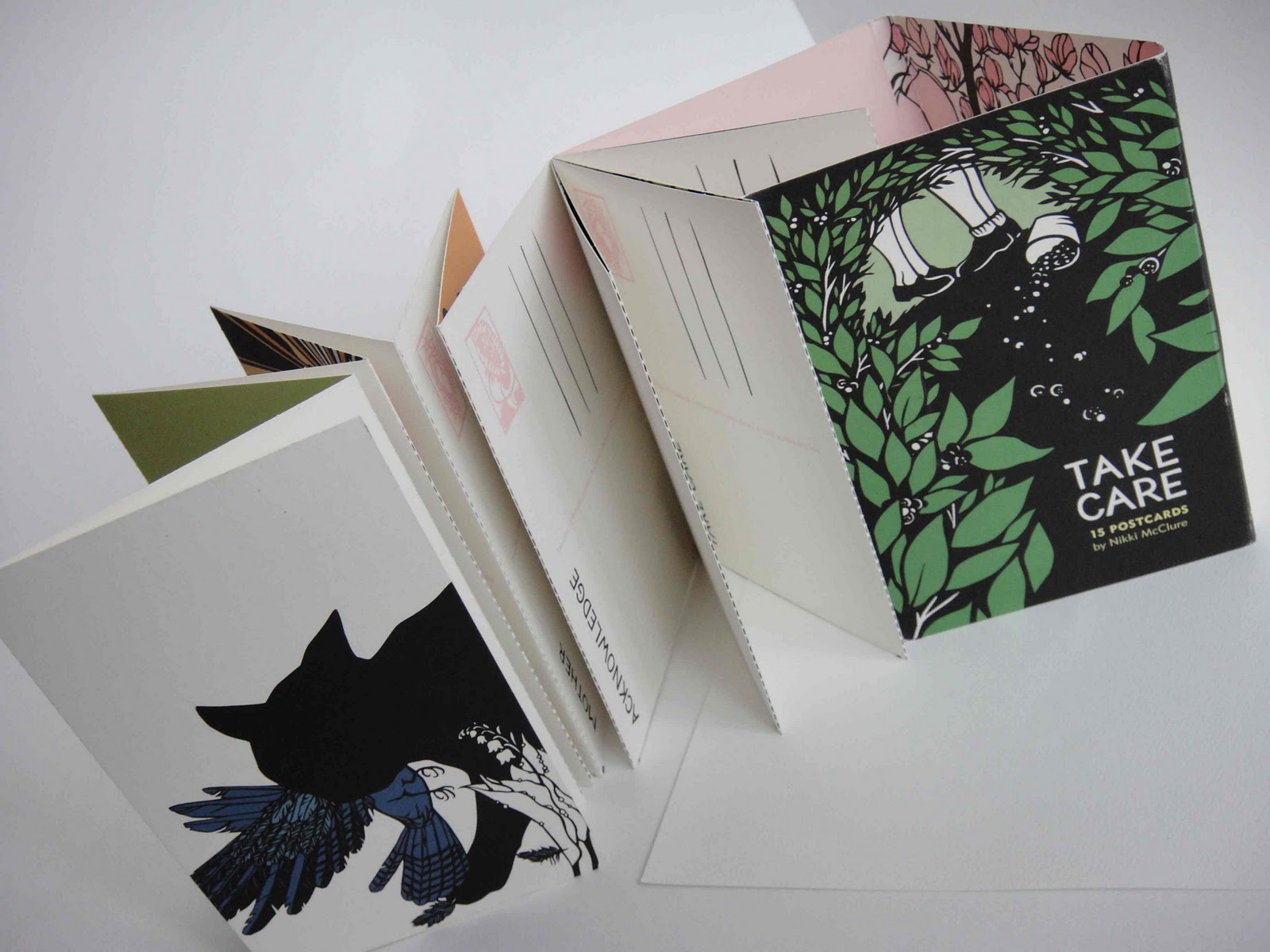
Nikki McClure, Take Care, San Francisco: Chronicle Books, 2009 [perforated accordion postcards]


A sharp set of 17 paper-cut images published as postcards in an accordion strip. Nikki McClure is a self-taught artist who has been making paper-cuts since 1996. Individual page: 5.75" x 4", total length: 5' 8" For more information about the artist Nikki McClure 


Sunday, December 11, 2011

A Child's View From Gaza, perforated accordion postcard strip, MECA, Berkeley, 2011


A Child's View From Gaza is a traveling exhibit of drawings and paintings created by children in the aftermath of Israel's three-week assault on Gaza in the winter of 2008-09. The pictures show what they saw and experienced, their fears and their dreams for the future. 

Children's Art Censored The Middle East Children's Alliance (MECA) arranged for the Oakland Museum of Children's Art (MOCHA) to host the exhibit for two months in 2011. Then the museum abruptly canceled "A Child's View From Gaza," following intense pressure from pro-Israel groups who did not want the art to be shown. But hundreds of people have seen the art at a rented storefront and thousands view it on online. 

Let the Children Play and Heal is a MECA supported project where most of the art was created. This project helps tens of thousands of children in Gaza cope with trauma and fear by engaging them in the arts and sports; educating mothers and teachers about children's psychological needs; providing referrals for therapy; and written information on trauma for families and communities. [above text accompanies this postcard strip] 

Catalogue (see last photo) available from: "A Child's View from Gaza: Palestinian Children's Art and the Fight Against Censorship" book | Middle East Children's Alliance For further information, and documentation of the alternative exhibition venue and opening events on September 23, 2011 see: MECA Opens "A Child's View From Gaza" Exhibit on Schedule at New Venue in Oakland, 9/24/11: photos & video : Indybay

Tuesday, December 6, 2011

Deb Sokolow accordion books


Briefcase Exchange, Men’s Bathroom, McDonalds, Washington, D.C., 1986, 2010. Graphite, acrylic, ink, collage on acid-free paper, 
accordion fold, hard-cover 
6" X 9". Unique edition of 5.

Whatever Happened to the Pentagon (restaurant)?,
2007.
Toner with ink and marker on cardstock with manila folder cover, 11 3⁄4” x 9 1⁄2”. Edition of 100.

These two accordions are from a group of seven that can be viewed at Western Exhibitions, a contemporary art gallery in Chicago that represents Deb Sokolow: Deb Sokolow Western Exhibitions The accordion format offers her quirky conspiratorial drawings/maps/diagrams/comics a wonderful panorama through which these complex, and multi-layered stories, can be seen and read.

Check out this charming video of her talking about her work, A look inside the artist's studio, a commission for the lobby of the Museum of Contemporary Art, Chicago, that was part of the exhibition Production Site: The Artist’s Studio Inside-Out, February 6 - May, 30, 2010. Deb Sokolow @ MCA, Chicago - YouTube

Sunday, December 4, 2011

Stan Shellabarger, Dragging Book, 2009, drypoint prints on paper
 MDF cover with steel printing plate


A fascinating artists' accordion book by this body & performance artist who uses different processes, including walking, to create his conceptual and time-based sculptures, drawings and bookworks.

For this book "Stellaberger hung ten galvanized steel plates end-to-end horizontally on a wall. Wearing gloves whose fingers were covered with coarse grit sandpaper, he paced back and forth, dragging his hands across the plates. He printed the resulting plates like one would a drypoint print. The prints were then trimmed, hinged together, accordion folded and placed between two waxed MDF covers with one of the steel plates attached to the front cover." [text from a description of the work at Western Exhibitions, a contemporary art gallery in Chicago] 

Edition of 10, individual sheet size 7.5” x 13.5”, open size 7.5" x 120" Western Exhibitions

Tuesday, October 11, 2011

Accordion Installation, Great Poor Farm Experiment III, Manawa, Wisconsin, August, 2011


A temporary accordion installation that I created this summer at the third Great Poor Farm Experiment deep in the Wisconsin countryside. The goal of this wonderful artist-initiated project is "...to facilitate and present artists' projects and year-long exhibitions at the former Waupaca County Poor Farm (built 1876) in Little Wolf, Wisconsin. First and foremost, the Poor Farm is a facilitator, generating new possibilities for artist’s projects and exhibitions." For more information about: Poor Farm | ABOUT

Thursday, October 6, 2011

Read-in Manual (magazine insert), C Magazine (Libraries issue), Autumn 2011, Toronto, Canada


An accordion insert in the 'libraries' issue of C Magazine that's a manual for a fascinating project that involves initiating reading sessions in stranger's homes. On the back of the insert is information about this project and an outline of how the collective initiates their read-in actions. The text below has been taken from their website http://www.read-in.info/index.html

"Read-in is the collective effort of instigating instant reading sessions in other people's homes. Initiated in February 2010 in Utrecht, NL by artist Annette Krauss and theatre maker Hilde Tuinstra, this evolving experiment in group reading delves into a process of unusual social activity involving ringing neighbours' doorbells with the request to host the collective reading. Through conceptualising the permeation of private space and communalising a typically solitary activity, the Read-in practice calls attention to the relationship between the content of a book and the reading of a place, opening up new understandings of the material, affective, and political dimensions of ‘reading together.’ 

After a year of monthly actions, a few members of the current 'Read-iners' have formed a research team to contextualize the reading practice and expand it towards other ends, as well as to grapple with ideas of representation of this practice for various contexts. How to communicate and effectuate "the material, affective, and political dimensions" of Read-in? 

Read-in is developed in collaboration with The Grand Domestic Revolution—User’s Manual’ (GDR) a long-term collective research project initiated by Casco - Office for Art, Design and Theory."

Monday, August 8, 2011

Geza Perneczky, Post Infinite, 1984, Koln, Germany


A four page accordion made with white rubber stamps and overprinting minimalist designs. Perneczky is a writer, historian and artist/networker who divides his time between Koln, Germany and his homeland of Hungary. He has published two important books on the history of artists' periodicals.

Friday, July 15, 2011

La Prose du Transsiberian et de la Petite Jehanne de France, poem by Blaise Cendrars & artwork by Sonia Delaunay, facsimile of 1913 version, 2008, Yale University Press, New Haven


A really wonderful facsimile of the 1913 original that features Blaise Cendrar's free verse poem describing a real or imagined trip across Russia and printed in an assortment of type fonts and sizes. Combined with Delaunay's 'simultanist' abstract work this early artists' book still exudes the excitement and vitality of this collaboration between two important Paris-based pioneers of early 20th century modernism.

Presented as a two-sided accordion with the artists' works on either side, the work then opens up further into a long single sheet in which the image and texts are brought together.  83.75" (H) x 7.5" (W). 


Sunday, June 26, 2011

Sampler Italiano, Darden Concepts, 2011


Liberated from Olive Garden restaurant, Green Bay, Wisconsin, June 16th, 2011. 10" (H)  16.5" (L)

Julia Rothman, Jenny Volvovski & Matt Lamothe, The Exquisite Book, San Francisco: Chronicle Books, 2010


I was in San Francisco last week and quite by chance I come across this remarkable accordion book at Green Apple Books on Clement Street. Utilizing the Surrealist game of 'Exquisite Corpse' the editors invited 100 illustrators to contribute one page to this project. The artists were placed in 10 groups with the first artist in each group being given an open-ended phrase with which to start each section. The final book contains 10 double-sided accordions (!) that are made up of 10 artworks and 2 pages that contain the phrase for each accordion.

This is a really wonderful publication that I'm sure created all kinds of headaches & challenges for the printers & binders — but it's a gem. The images are first class and they come together to create some smart and unexpected juxtapositions. The book also includes short interviews with a number of the artists, as well as biographical information for them all. Aside from the 2 publications from La Dernier Cri (France) documented earlier in this blog, this book stands out as one of the most technically innovative accordion publications that I've come across! If you only buy one accordion this year, make it this one - you won't be disappointed. Each individual accordion is 9" (H) 3.75' (L)

Thursday, June 2, 2011

Art: From Prehistoric Art to Modernism (Flipguide), 2001, DuMont Buchverlag, Koln

The accordion format is ideally suited to displaying large amounts of information in a sequential and chronological format. This accordion catalogues art works made over the last 35,000 years. 12" (H) 67.50" (W)