Saturday, February 26, 2022

Pascale Estellon, ABÉCÉDAIRE, Editions des Grandes Personnes, Paris, 2016, 2nd edition

Cover of the book's wraparound cover

This is a really well designed abécédaire or alphabet book, with 2 page spreads for each letter coupled with many foldable and interactive elements inserted throughout. The book feels comfortable in one's hands and the paper is thick, with a firm quality, that I'm sure would bear up well in its interactions with very young people and their inquisitive hands and fingers!

26 double-sided pages, individually 11.75" x 8.25" and when fully opened 17ft 10.5".

Front page of the accordion


Reverse side of book


Back page of the accordion

Cover of the wraparound cover


Thursday, February 24, 2022

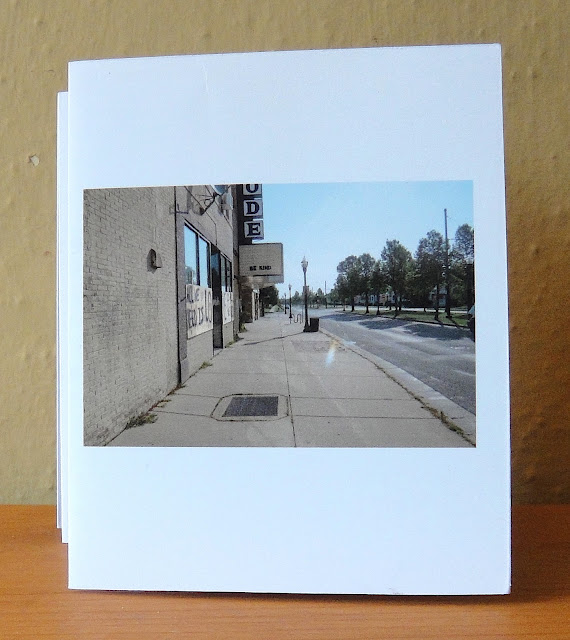
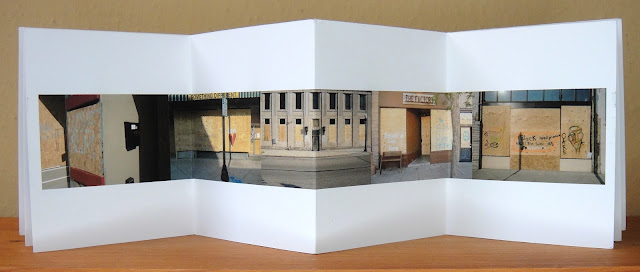
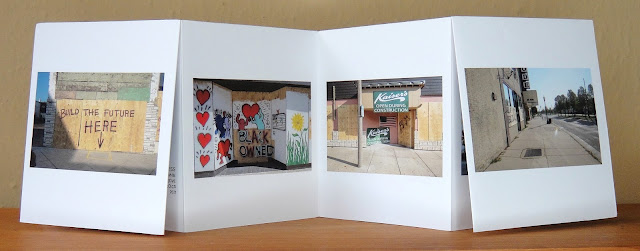
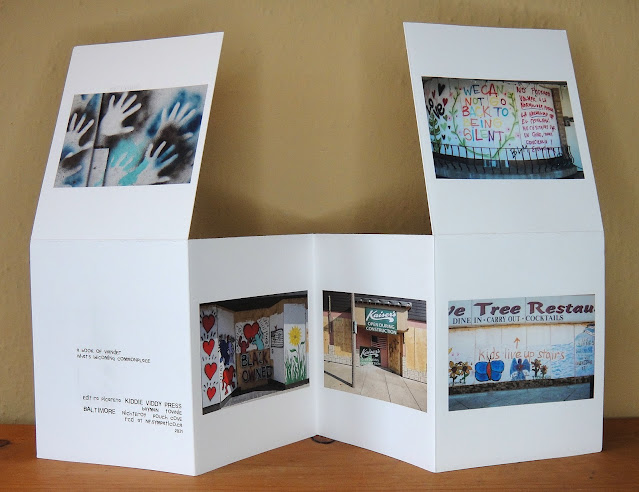
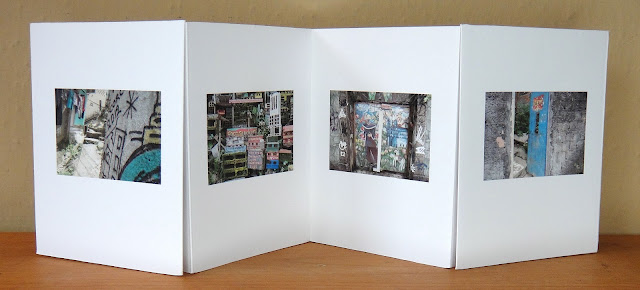
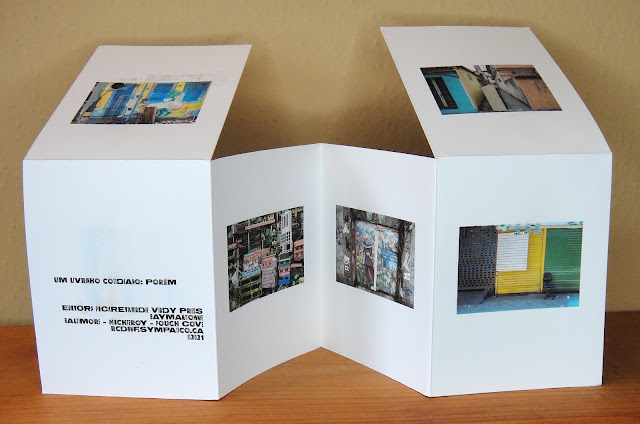
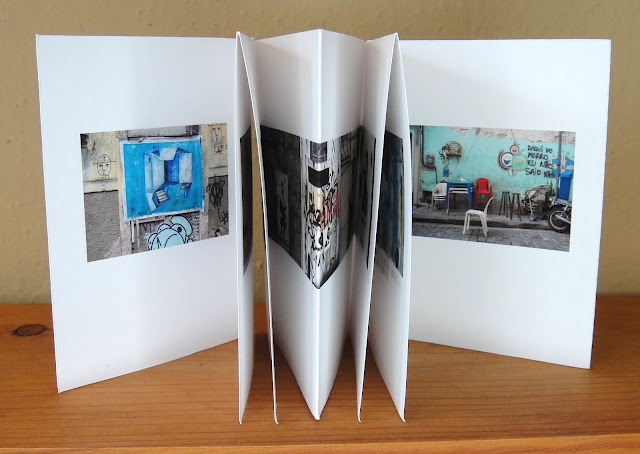
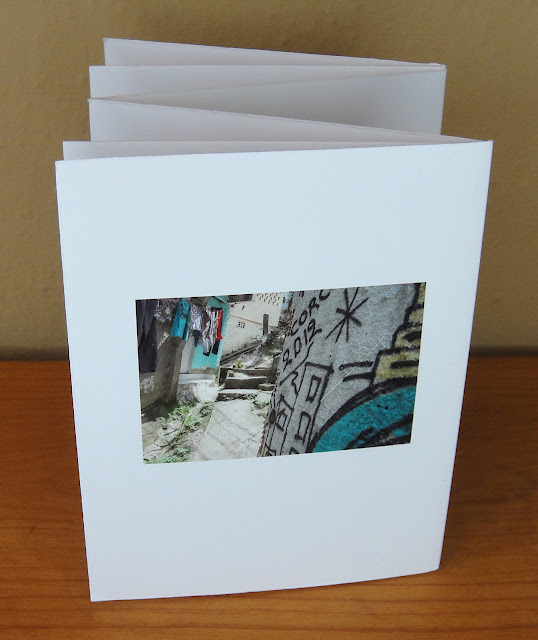
R. Clarke-Davis, "a bOOK OF WaNdER What'S bECOMINg cOMMONPLaCE," and "Um Livrinho Cotidiano: Porém," Kiddy Viddy Press, 2021

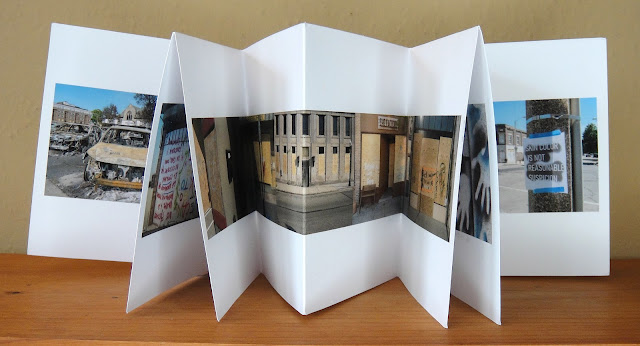
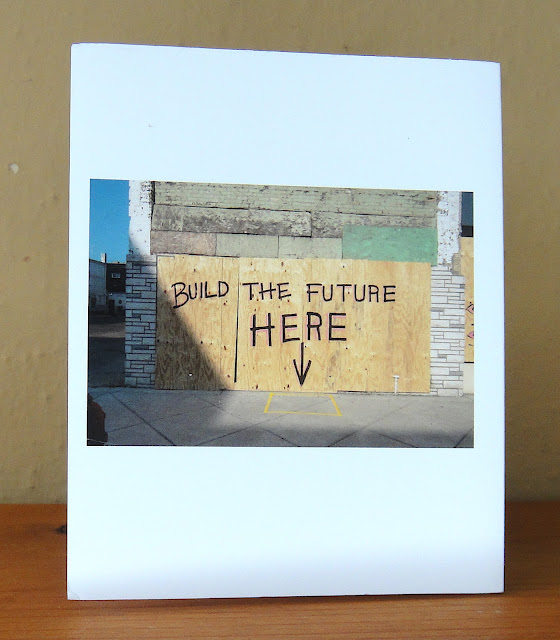
Two recent accordion/puzzle books from Clarke-Davis. The first one, a bOOK OF WaNdER What'S bECOMINg cOMMONPLaCE, is the most explicitly political of the books he's sent me. All the photographs were taken in the town of Kenosha, Wisconsin, which has recently become infamous for the acquittal of 17-year old Kyle Rittenhouse in the killing of 2 anti-racist demonstrators and injuring another, during a protest against the police shooting of Jacob Blake. This work is a powerful paean to the events that have unfolded in Kenosha since Blake's shooting on August 23, 2020, and the final photograph on the back cover literally points to how much work has to be done as we move forward.

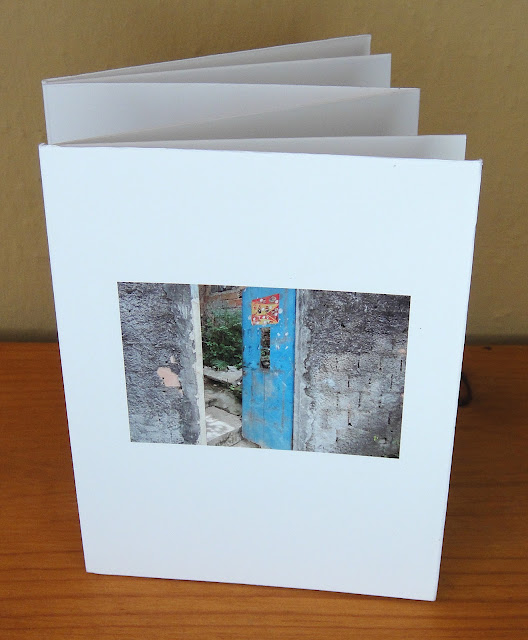
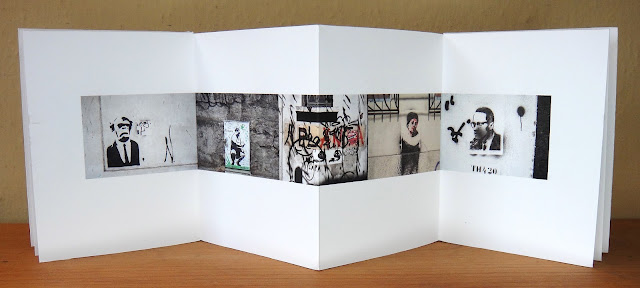
The second accordion, Um Livrinho Cotidiano: Porém is a travel journal with photographs from Brazil (I think!) with a powerful central panorama of 5 photographs of street art.

Both books: 10 double-sided pages measuring 5.5" x 4.25", when opened 17" x 5.5", and when the work is unfolded 11" x 17".

a bOOK OF WaNdER What'S bECOMINg cOMMONPLaCE, 2021


Back Cover


                               Um Livrinho Cotidiano: Porém, 2021


Back Cover

Wednesday, February 23, 2022

Bill Gaglione, Fluxus, 2022


A surprise accordion from Picasso Gaglione in Knoxville. Definitely a minimalist piece from this post-dada artist — stripped down to the basics with its four rubber stamped letters on the humblest of materials. Fluxus Lives!

3 double-sided pages, individually 16" x 10", and when fully open 2' 6".


Back of the accordion


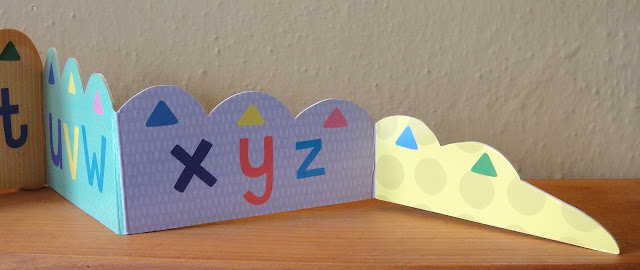
Sally Pine, Alphabet Alligator, Autumn Publishing, London, 2021


I recently took a dive into looking at other types of accordion books, and I surfaced amongst the longstanding tradition of children's alphabet books. I realized also that there are a number of alphabet books already posted on this blog with Marie Bataille's being the most recent. Either way, with this particular book I enjoy the play with the accordion/alligator shape, plus it looks like a really fun way to learn the basics of language and the alphabet!

10 double-sided pages, various sizes from 5" x 5.5" to smaller, and when fully open 4.5 ft.


Reverse side of the book

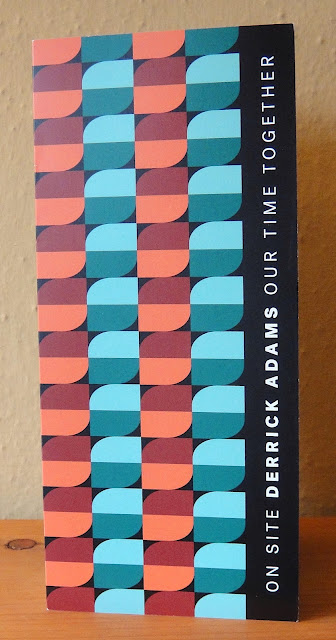
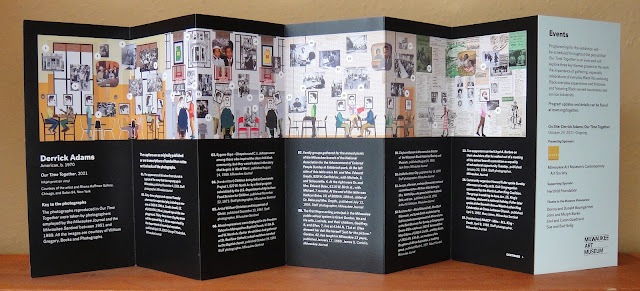
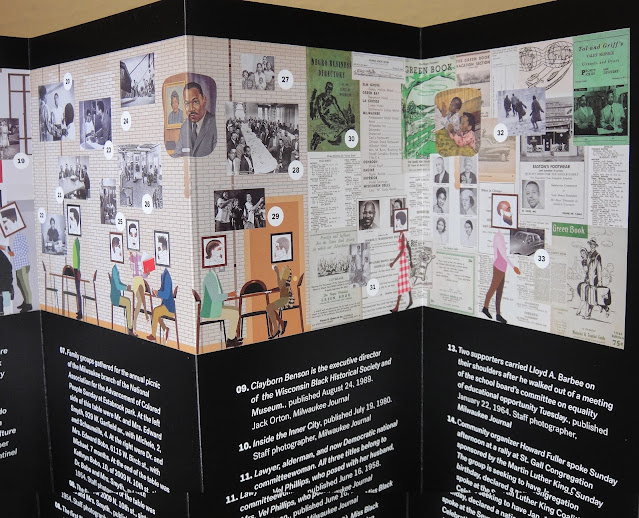
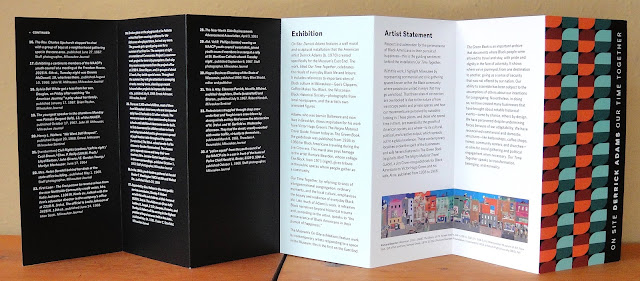
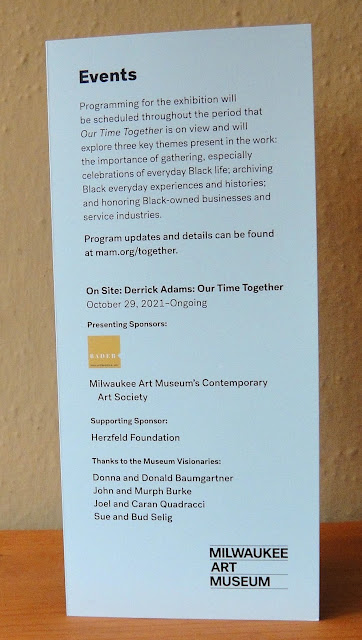
Derrick Adams, Our Time Together, inkjet print on vinyl, 2021


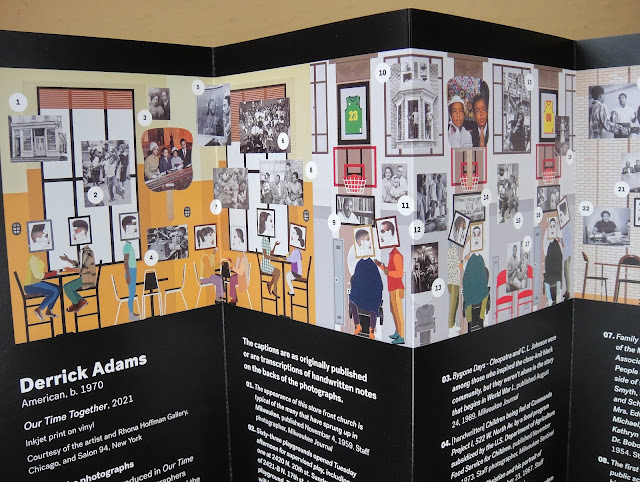
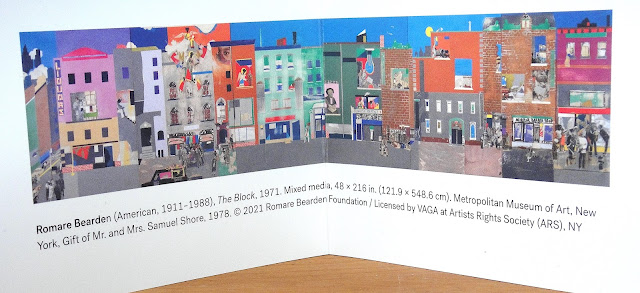
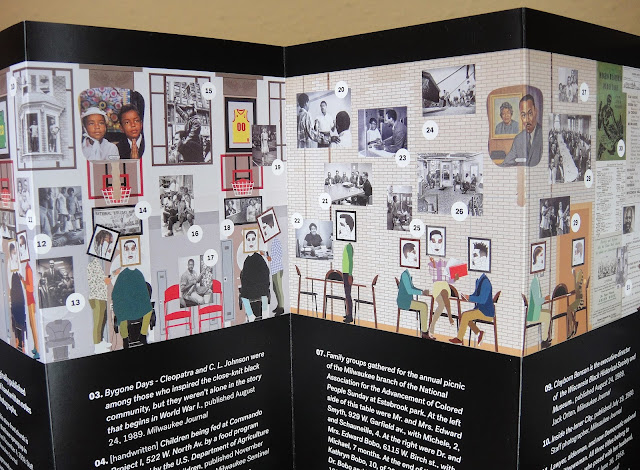
This accordion is the catalogue for a site specific mural created for the Milwaukee Art Museum. The work celebrates the rituals of Black life and leisure, and includes important sites of Black culture in Milwaukee, and combined with Adams' figures are photographs from The Milwaukee Journal illustrating these sites and the people associated with them. This catalogue has numbers inserted throughout that refer to a list of descriptions of handwritten notes that have been transcribed from the backs of the original photographs. This mural also pays homage to Romare Bearden's collage "The Block" (1971) which also celebrates public spaces where people gather.

Adams, a Brooklyn-based artist, writes the following in his statement about this work:

"Respect and admiration for the perseverance of Black Americans in their pursuit of happiness—this is the guiding sentiment behind the installation "Our Time Together."

With this work, I highlight Milwaukee by representing commercial and civic gathering spaces know within the Black community, where people are united in ways that may go unnoticed. That these sites of connection are overlooked is due to the nature of how we occupy public and private spaces, and how our movements are perceived by outsiders looking in. These places, and those who spend time in them, are essential to the growth of American society as a whole—to its cultural, political, and creative output, which spreads out to a global audience. These contemporary localities evoke the spirit of the businesses and safe havens featured in "The Green Book" (originally titled "The Negro Motorist Travel Guide"), a Jim Crow-era guidebook for Black Americans by Victor Hugo Green and his wife, Alma, published from 1936-1966.

"The Green Book" is an important archive that documents where Black people were allowed to travel and stay, with pride and dignity in the face of adversity, from one destination to another, giving us a sense of security that was not offered by our nation. Our ability to assemble has been subject to the assumptions of others about our intentions that have brought notable historical events—some by chance, others by design. We have persevered despite undermining forces because of our adaptability. We have reconceived commercial and domestic structures—like barbershops, coffee shops, homes, community centers, and churches—as sites for social gathering and political engagement when necessary. "Our Time Together" speaks to transformation, belonging, and normalcy."

Thanks to Lewis Koch for bringing this accordion to my attention!

7 pages double-sided, individual pages 9" x 4", and when fully open 2ft 4".


Reverse side

Romare Bearden (1911-1988) "The Block," mixed media, 1971

Back cover


Tuesday, February 22, 2022

Mat Brinkman, Linchetto, Hollow Press, Italy, 2019, ed. 400

Front Cover

This is a dark and funky accordion that takes the legend of the mischievous sprite, Linchetto, who lives in the Italian provinces of Lucca and Garfagnana, as its inspiration and subject matter. Below is a cool explanation of Linchetto from the Tuscan travel company Toscaninside.com.

"In the Province of Lucca and in Garfagnana, if anything of yours goes missing or if it seems to have been inexplicably moved, the locals will not hesitate to give you an explanation: it's all because of Linchetto! What is all this about? Linchetto is a rather mischievous sprite who may also resemble a naughty breeze that ruffles the leaves. When the wind stops he turns into a living creature - yet no one really knows what he looks like as he never reveals himself! He is sometimes described as a skinny little man with a beard and a red hat, just like Papa Smurf! For others he seems to have the appearance of a strange creature half human, mouse and bird-like.

But what is this wicked sprite really up to? To start with, he seems to wander around especially at night, and likes the countryside though he does not disdain old town houses either! He always finds the most haphazard ways to have fun – indeed you can hear him sniggering loudly, or see him intent on pulling the blankets off those asleep, or even worse, sitting or treading on their chest to make them choke. He seems kind to children who he gently caresses but cannot stand grannies! He knocks on doors at night, he hides objects, moves them about, and makes inextricable knots on the animal tails in the stables...

How can you fend him off? As he seems to be rather meticulous, juniper branches always work: he cannot help but count the leaves, eventually gets bored and hence walks away! Same thing with spell or chickpeas that should strictly be kept on the bedside table: he will try to count them but in the end will lose track and get bored, looking for someone else to bother. If you go to Lucca or Garfagnana, you have been warned, but do not be intimidated! It is true that children are told to behave if they do not want to be taken away by Linchetto, but in reality he has never hurt anyone! It even seems that when he sees a housewife bogged down with chores, he secretly finishes some of them off for her!"

4 double-sided pages, each page 13" x 9.5", and when fully open 3ft 2".


Reverse side


Back Cover


Thursday, February 10, 2022

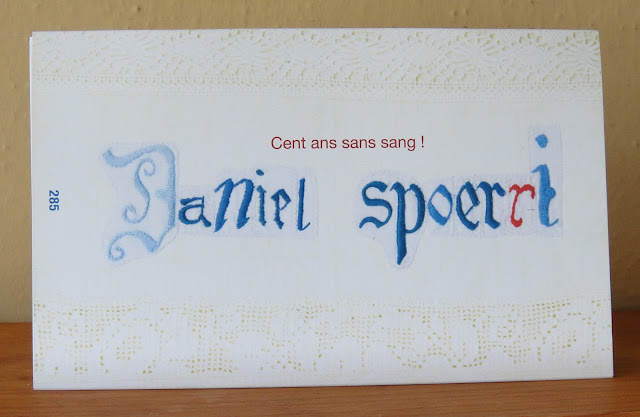
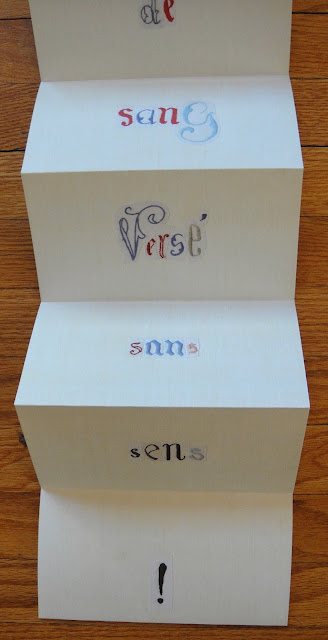
Daniel Spoerri, Cent ans sens sang! (A hundred years without blood!), Editions Jannink, Paris, 2017


This is a fascinating accordion by this longtime Swiss avantgardist (1930-2024) who is perhaps best known for his "snare-pictures," which consist of table tops with the remnants of meals glued onto them, and hung vertically on a wall.

Invited to do the 100th issue in a series of artists' publications that Editions Jannink has been publishing since 1978, Spoerri came up with "Cent ans sans sang!".  In the opening pages of the 'book' part of this publication, Spoerri recounts how he'd refused three requests to do this issue, but then "someone pointed out to me the double meaning of 100/cent and sans/sens and explained to me that Max Ernst would have referred to the fact that in their erotic fantasies, men never imagine faces but always bodies and sexes." Spoerri is referring here to a book of collages that Max Ernst published in 1929 titled "La Femme 100 têtes," (The Hundred Headless Women) of which he had seen the originals, and had clearly been impressed.

In the publisher's introduction to this accordion they state that Spoerri "...plays on the homonyms of the word "cent" (100), a kind of tribute to "La Femme 100 têtes," by Max Ernst. Using the multiple meanings given to a unique sound, would Spoerri compose, in one sentence, a true pacifist commitment?".

This is where this publication becomes problematic for me - it's in the "homonyms" part of it!  A homonym is "each of two or more words having the same spelling or pronunciation but different meanings and origins."  ie. lead (the metal) and lead (as in the verb), or there and their.

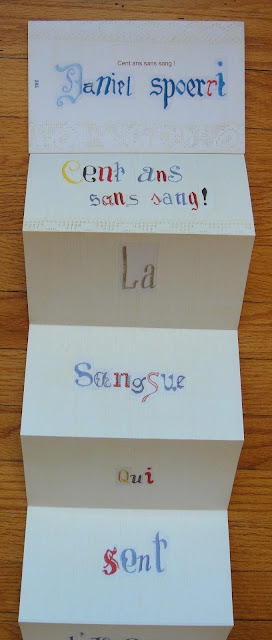
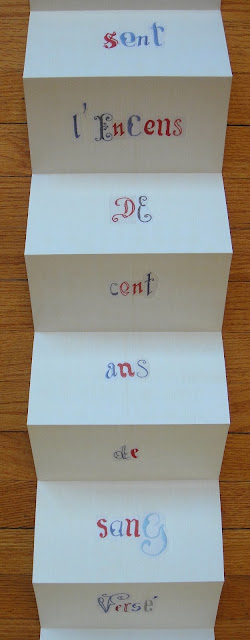
Since French is not my first language, although I studied it long enough in school, I'm not getting the subtleties of the wordplay here!  However, google translate did seem to do a good job of the wordplay that runs down the whole length of the work reading: "the leech who smells of the incense of a hundred years of meaningless spilled blood!". Nothing subtle about that!!

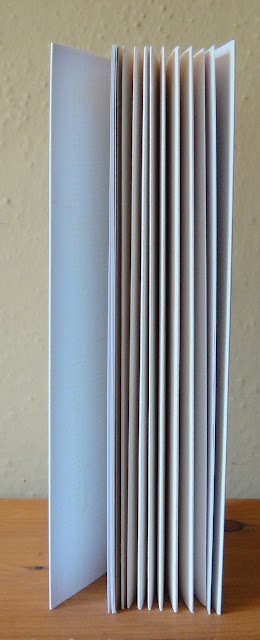
16 single-sided pages, each 4.5" x 8" and when fully open 6 feet.


back cover


Wednesday, February 2, 2022

Ian Hamilton Finlay, A Rock Rose, with Richard Demarco, information sheet for The Wild Hawthorn Press, c. 1971

This is a simple information sheet publicizing Finlay's 'Wild Hawthorn Press' coupled with comments about the press from such worthies as Something Else Press and Art International.  But it's the image on the front (originally a print) that intrigues me, as once again Finlay's preoccupation with water, sea, and sailing comes to the fore, coupled with the 'rock' juxtaposed with the delicacy of the 'rose.' 

3 pages single-sided, each 4.74" x 7", and when fully opened 2' 7".