Friday, July 21, 2023

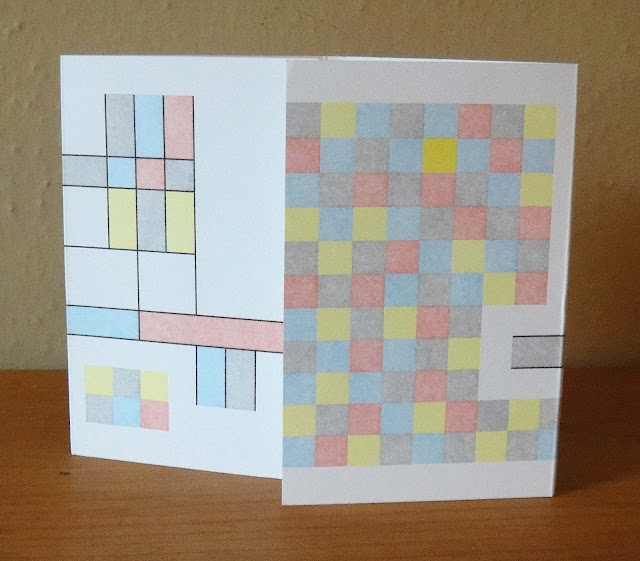
Romano Hänni, Words make the Infinite Finite (V), Basel, Switzerland, 2018, ed. 86

the accordion in its packaging

This is the second of Hänni's accordion books that I have featured on this blog and its another interesting one from this Swiss artist and typographer who's using a totally abstract palette to express his "desire to reach the 'infinite' beyond the limitations of words...". It's a curious coincidence that another Swiss illustrator and designer Warja Lavatar (1913-2007), also used a totally abstract system in her groundbreaking use of the accordion format throughout her artistic career. I consider Lavatar as one of the earliest pioneering artists to have adopted the accordion format as an integral part of her artistic practice, publishing her first accordion book in 1962. Follow this link to see another publication of Hänni's on this blog: 

Here's a statement from Hänni's website about this work and he addresses what he's trying to do with his purely visual works:

Although language can be explanatory, only signs and symbols evoke notions. They are capable of simultaneously incorporating all levels of human existence. Reaching down to the unfathomable depths of the soul grow their roots. Like a gentle breeze, language only touches the surface of understanding. Words make the infinite finite, signs and symbols carry off the spirit into the realms of the infinite world of being. They evoke notions, are signs of the unspeakable and are equally inexhaustible. 

Without signs or symbols, even the most modern of world views becomes impoverished. The division of soul and spirit has much to do with Gutenberg's invention. For the sake of the modern, supposedly unnecessary yet reliable and irreplaceable things are often sacrificed. Access to signs and symbols could lead to peace of mind in which all unconscious is not anxiously blocked out and avoided but embraced as a way of expanding consciousness. In this manner, the spirit could find a way out of self-isolation in which it is held captive by its unconditional worship of science and technology.  [Romano Hänni, Studio for Design]

10 single-sided pages, individually 4.75" x 3", and when fully unfolded 2' 6".

accordion with bilingual explanatory pamphlet

back cover with pamphlet


back and front covers


Thursday, July 20, 2023

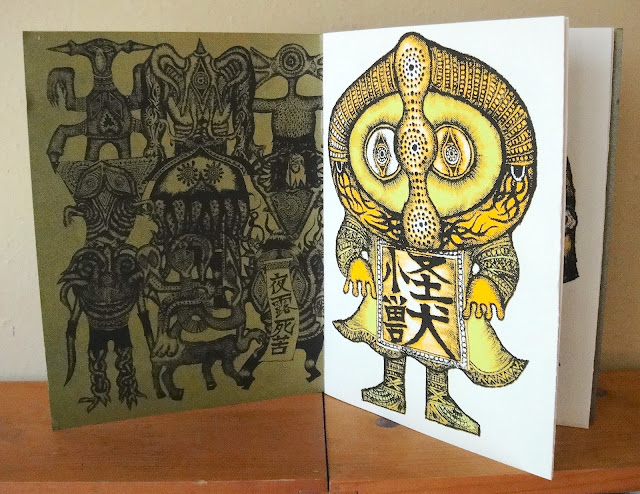
Masayoshi Hanawa, Monster 2, Le Dernier Cri, Marseille, France, 2020, ed. 150

Continuing my inquiry into books with folds, here's another great folded book from Le Dernier Cri. Masayoshi Hanawa is a Japanese artist who has become known for his ongoing series of monsters in both print and 3 dimensions. Some of the spreads from this silkscreen book come close to that of accordion books, but either way with images as powerful and compelling as these formal details seem to fade away!

8 double-side pages, individual pages 11.75" x 8.5". center spread 2' 10".


back cover

R. Clarke-Davis, a commonplace book: icarus (2023) & a commonplace book: tidying (2010-2023), Kiddie Viddy Press, Wi

Two new accordions by R. Clarke-Davis with the first one a very visual representation of the tale of Icarus who perished by flying too close to the sun with his waxen wings. Clicking on the images enlarges them significantly and allows for the subtlety of the photographs to be appreciated.

The second book 'tidying' which is in Clarke-Davis' puzzle book format that includes two folded wings that add an extra dimension to the accordion and another element in his play with the book's images. 'Tidying' appears to be a meditation on everyday objects found within his domestic environment with one photograph showing a pile of his artists' books and the materials & instruments used in their making. In two of the final photographs I have opened up the book to reveal its architecture as well as revealing the cut in the middle of the paper that creates this unique format.

There's a large body of accordion works by Clarke-Davis in this blog and with a quick search you can discover them for yourself!

a commonplace book: icarus (2023) 


12 one-sided pages, individually 4.5" x 5.25, and fully opened 5' 3"

_______________________________________________________________

a commonplace book: tidying (2010-2023)


back cover

8 double-sided pages, plus 4 pages in the flaps, individually 5.5" x 4.25, 
and fully opened 2' 10"

Barbara Cesery & Marilyn Zuckerman, Monday Morning Movie, Street Editions, New York City, 1981


An interesting collaboration between visual artist (Cesary), and poet (Zuckerman) that explores a range of notions intertwined within the idea of romantic love. They illustrate this theme through poems dedicated to well known movie stars and actresses, such as Billie Holiday, Mae West, Marilyn Monroe, Jane Fonda and James Cagney to name but a few. Cesary's images that accompany the poems would appear to be images taken from family albums and they embody another kind of love and intimacy that is found within the family unit. 

The image (above) of the three young women at the beginning of the accordion for me sets the emotional tone of the book as one based in the yearnings and desires of young women such as these three. This book, through its combination of words and images, illustrates the pangs of love & romance of late adolescence as well as all the difficulties & disappointments and the beauty, of this early period of their lives.

54 double-sided pages, individually 6" X 8" and when fully open 13' 6".


reverse side


back cover

Wednesday, July 19, 2023

Maricela Guerrero (trans: Stalina Villarreal), Kilimanjaro, Cardboard House Press Cartonera Collective, Pheonix, 2018


A bi-lingual cartonera book in a rare accordion format with writings by the Mexican author who's published a number of books of poetry. In collaboration with Paula Abramo and Xitlalitl Rodriguez they authored Ropa Sucia, where they exposed the difficulties & problems that women writers encounter and how these issues work to render them invisible.

The cartonera publishing movement originated in Argentina in 2003, and utilizes one of the most available of materials, cardboard with which they create wildy creative and varied handmade covers for their publications, all of which are priced affordably for the person in the street - you could call it the democratization of literature.

I particularly like the hand painted and stenciled front and back cardboard covers to this accordion. However, it also illustrates that large amounts of text are not necessarily best suited to this format which requires a greater visuality in order to make the most of this unique folded format, as well as engaging the viewer.

19 double-sided pages, individually 8" x 8" and fully opened 12' 8".

reverse side


back cover

Stéphane Calais, The Wall, Editions Hoëbeke/Havas, Paris, 2012


accordion with slipcase

A very fancy production for this accordion that documents Stéphane Calais' monumental painted mural that takes up 30,000 square metres of wall space in the new offices of the esteemed French international advertising & public relations agency Havas, that was founded in 1853 by Charles Havas.

The mural is a series of interlocking works that create a lively and stimulating environment without overwhelming the space of the office's corridors. Calais in a text in this book explains this work writing, "The extensive wall paintings created for the Havas building are interlinking landscapes. Each location has its specific nature; each place is unique and shows it. The link between them is made in line and color, of course, but also by allusions to shapes and space." Calais concludes "This project expresses a single idea, that of a specific, completely new, innovative and vibrant space."

34 double-sided pages, 10.5" x 8.25" and when fully open 23' 4.5".


reverse side