Friday, October 13, 2023

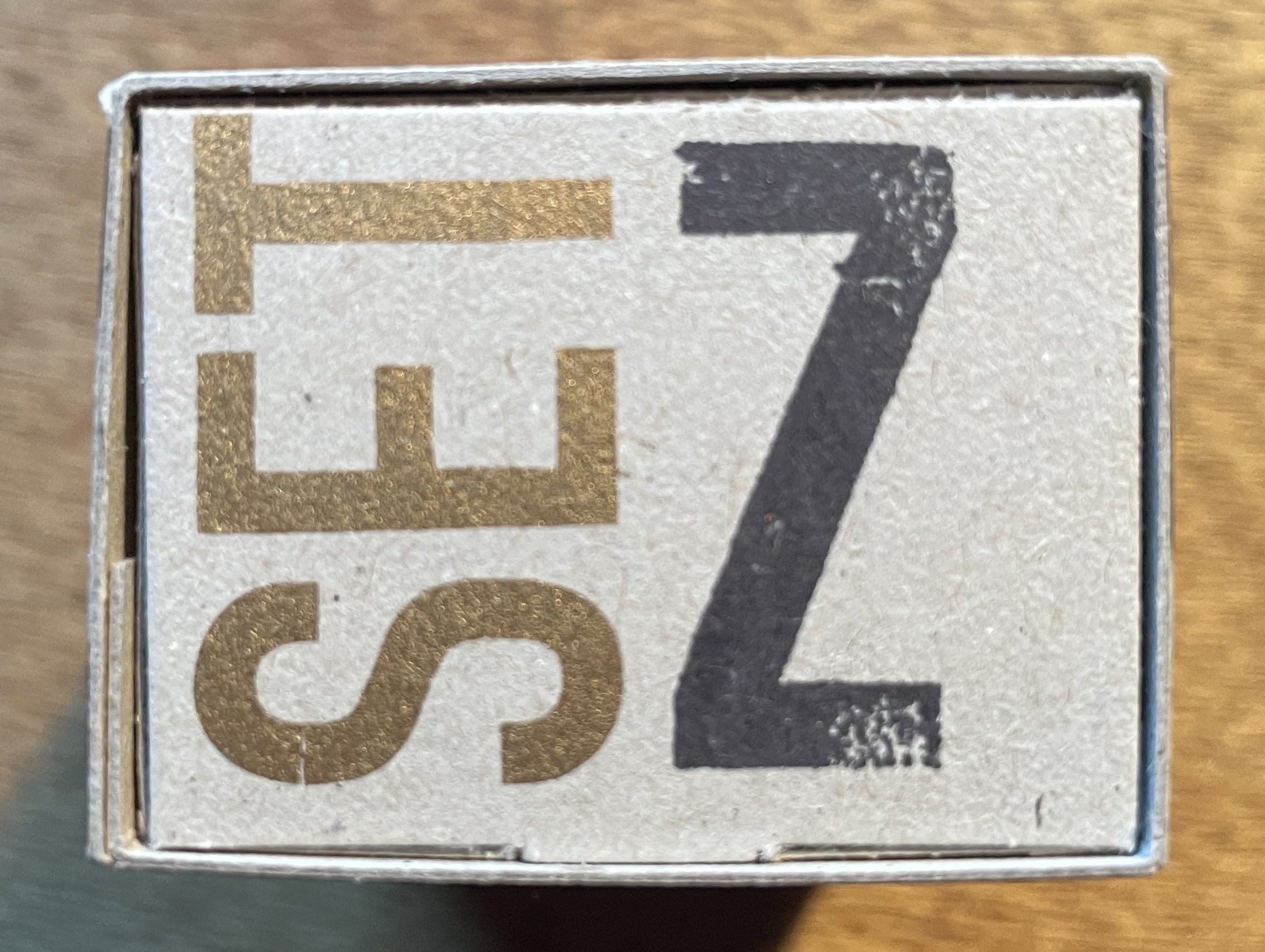
Box 2W/Set Z, 2013, and Box 2W/Set Y, 2012, 10 artists, B.ü.L.b. Comix, Geneva, 2012-13

                                                     Box 2W/Set Z, 2013


B.ü.L.b. is a cool "independent sequential art publishing house" that was founded in 1996 by Nicolas Robel with a DIY aesthetic and a political attitude. These two boxed collections, each containing 5 miniature accordion works by 5 international artists, are part of a larger print project in which a boxed collection was produced for each letter of the alphabet. This is a wonderful way of making available a large number of different artists' works in a unique and affordable format - bravo to B.ü.L.b.!

Other B.ü.L.b. productions, including larger printed editions and books can be viewed at their website: B.ü.Lb comix

Each accordion is 11 pages, double sided. Individual pages 1.75" x 1.25" and when fully open 1ft 1.75". Note: click on images for larger size.


Jockum Norstrom (S)


Yuichi Yokoyama (J)


Elvis Studio (CH)


Blexbolex (F)


Nicholay Baker (T)


_______________________________________________________________

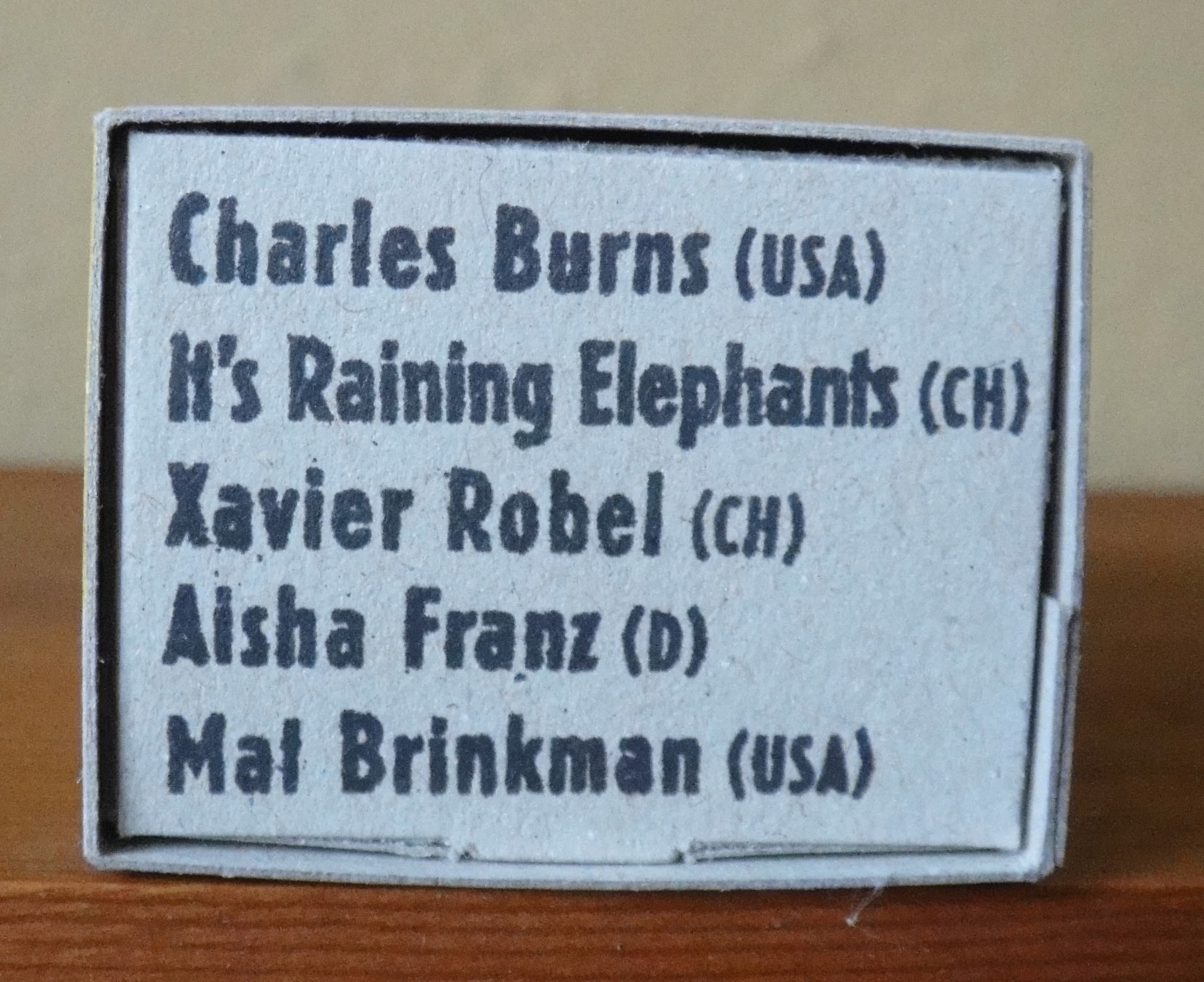
Box 2W/Set Y, 2012


Charles Burns (USA)


It's Raining Elephants (CH)


Xavier Robel (CH)


Aisha Franz (D)


Mat Brinkman (USA)


Enrico Baj, BAJ: ebanisterie e mobili (cabinet making and furniture), Galleria Schwarz, Dec. 2, 1961 - January 12, 1962, Milan, 1962

I didn't really know what I was getting when I purchased this catalogue online, but what attracted me was its faux wooden cover. I knew Baj (1924-2003) as an Italian artist with an outsider aesthetic, who was also an anarchist and involved with the Milanese avant-garde of the mid-1950s. In 1951 he was the co-founder with Sergio Dangelo of the arte nucleare movement, whose aim was to make art in response to the nuclear age. Probably best known for his series of paintings titled Generals which were absurdist representations of generals and political figures whom he lampooned and critiqued with a vengeance.

This series of Furniture paintings were made from actual scraps of furniture and mimic period design pieces. The catalogue includes an interesting text in three languages by Octavio Paz entitled "The furniture-pieces of Enrico Bay". The Surrealist writer Andre Breton also wrote about these works stating that "...the 'period furniture' shows the extent to which the enemy is capable of infiltrating the comfort of our homes, our 'easy chairs' and 'lounges' which mold him and conceal him...What a flagrant invasion of our intimate existence!"

10 double-sided pages, individually 9" x 6.25" and when fully open 4ft 8.25"


reverse with Octavio Paz text


back cover with Alfred Jarry quote "I was a cabinet maker for a long time."
Furniture works in situ in a room in Baj's villa
Copyright Archivo Baj, Vergiate, 2017, photography by Filippo Armellin
 

John Coplans, Self Portrait Frieze, Paul Bianchini Galerie Toner, Paris, 1994


John Coplans (1920-2003) was born in the UK and later moved to New York in 1971. Coplans started out as an artist and then "...along the way I got interested in talking about art. Very soon I became a critic. I wrote books and articles about art, edited a well-known art magazine (Artforum), and organized exhibitions of artists." In 1980 Coplans decided to start making art again and the subject of his work was to be his own body. The following quotes are taken from the website of the John Coplans Trust (The John Coplans Trust)

"I photograph my body. I generalize it by beheading myself to make my body more like any other man's. Nakedness removes from the body the specificity of time: unclothed, it belongs to the past, present and future. It is classless, without country, unencumbered by language, and free to wander across cultures at will.

A compelling influence on me has been the feminist movement and the reexamination of men's roles in relationship to women. In response, it is not only necessary for me to deal with the historical surface of consciousness, but also to examine the deeper, unconscious drives and image of manhood, revealing my hidden inner life is not without its comic aspects. I am both actor and spectator, create and dupe, inquisitor and squealer. Farce and force combine to reveal the human comedy.

My body is actively male and I view the world through it. But this is the expression of an existential rather sexual outlet. It is a broader category. My maleness is chance, not choice, and my imagery is more concerned with the psychosexual than with identity and anxiety. I try to regard the body and mind as inseparable, a single field of human experience that encompasses the perceptual, the intellectual, and the pains and pleasure of memory.

The natural aging of the body and mind plays a role in my work. The body's response to age is personally felt and can be observed by all. The mind, however, is another story. Personal and hidden, subject to the quirks stored in my memory's attic and in my genetic cells, scrambling art, history, science, politics, anthropology, and especially important to me, the idea of Jung and Freud—all of this demands my attention and recognition."  

It's interesting to me that Coplans calls this printed multiple a 'frieze' as there are many commonalities between the traditional frieze and the accordion - both are long horizontal bands of imagery & decoration with similar formal issues when it comes to the sequencing and narrative of its contents.

15 single-sided pages, individually 7.5" x 6" and when fully opened 7.5" length.


Sunday, August 13, 2023

Lillian Sizemore, A Folded Intervention, Subspace Gallery, Madison, 2023


This folded work was created during a Subspace Residency between August 7 - 13th, dimensions variable.

For more information about this Madison based writer, consultant and mosaic artist see: Lillian Sizemore


close-up


an update: i've just come across an interesting article in the New York Times' Style Magazine ("A Tangled Web," 9.24.23) about textile artists, and one of the featured artists is Marie Watt from Portland. Reproduced in the article is an image of a detail from a work of her's titled “Sapling” which is part of Watt’s “Skywalker/ Skyscraper (Twins),” 2020. The article goes on to state that she "...makes towers out of blankets that provide a commentary on life in the Pacific Northwest, including that of Indigenous people. One of her materials is treaty cloth provided by the federal government to the Seneca Nation, of which Watt is a member, as part of the 1794 Treaty of Canandaigua signed by George Washington."  Below is the image:


Monday, July 31, 2023

Sarah Nicholls, Elm Street (2021), Fish Creek (2019), Place Without Shadows (2020), & The Acclimatization Society (2018), Brain Washing from Phone Towers, New York, 2018-2021

A fascinating series of sharp and smart pamphlets that combine letter press (handset in metal type) and relief image (carved in wood or linoleum) with Nicholls describing recent pamphlets as "...primarily focused on urban landscapes and ecology, NYC history and neighborhoods, and how climate change will affect both human and non-human inhabitants of New York. They are distributed via the mail to a list of subscribers and friends, and represent an attempt to cultivate a 'reading private', an analog space in which to reflect, strategize, plan, mourn, and remember."

Consciously following in the steps of the early pamphleteers who had a long history of expressing their own opinions about matters of the day, often with a polemical social and political bent. Nicholls includes the following quote about pamphleteers by George Orwell in his introduction to his book British Pamphleteers (1948) at the top of her introduction to her works, and the spirit of these early publishers also mirrors the attitudes of today's zinesters:

"The pamphlet is a one-man show. One has complete freedom of expression, including, if one chooses the freedom to be scurrilous, abusive, and seditious; or, on the other hand, to be more detailed, serious and 'high-brow' than is ever possible in a newspaper or in most kinds of periodicals...Above all, the pamphlet does not have to follow any prescribed pattern. It can be in prose or in verse, it can consist largely of maps or statistics or quotations, it can take the form of a story, a fable, a letter, an essay, a dialogue, or a piece of 'reportage.' All that is required of it is that it shall be topical, polemical, and short."

With each entry below i'm including Nicholl's description of the works from her website: Elm Street - Brain Washing From Phone Towers

_________________________________________________________

Elm Street, 2021 [edition: 300]

Subject: History, Science, transportation
Elm Street is about: glaciers and what they leave behind; how trees communicate; roads that tell stories; driving as pleasure; landscaping as patriotism; and the advantages of underground fungi. Walking next to a high-traffic road is simultaneously pleasant and not. Join me on a walk down Eastern Parkway in Brooklyn, NY.

8 double-sided pages, individually 8.5" x 5" and when unfolded 3ft 4".


cover


back cover
_________________________________________________________

Fresh Creek, 2019 [edition: 300]

Subject: Botany, climate change, History
The last pamphlet of 2019 is about: transportation networks, bicycling in the city, the Jamaica Bay Greenway, landfills, Robert Moses, how to get where you need to go, Starrett City and their seaside view, and finally, the Shirley Chisholm State Part out in East New York. It follows a bike ride I took last fall that I particularly enjoyed. I hope you enjoy the pamphlet as well.

11 pages, individually 8.75" x 5" and when unfolded 4ft 7inches.

cover


back cover

_________________________________________________________

Place Without Shadows, 2020 [edition: 250]

Subject: climate change, History
Place Without Shadows is the second in three pamphlets on mapmaking and the past, present and future of Brooklyn's coastline. Come with me on a trip to Coney Island Creek, where we will visit three parks, and ask ourselves some questions. What is a beach? Where is the terminal moraine? What is the commons? What is a barrier island when it is no longer an island? What does the beach in your mind look like? How do you own something that disappears under the tide?

5 double-sided folded pages, individually 2.5" - 4", and unfolded 1ft 7inches.

front cover


accordion with top leaf unfolded (front)

accordion with top leaf unfolded (back)

back cover

_________________________________________________________

The Acclimatization Society, 2020 [edition: 250]

Subject: Birds, science
The Acclimatization Society is a new limited edition pamphlet about birds that are local to New York City, their adaptations, and survival tactics. Focused on select native and invasive species in their new urban habitats: the rock pigeon, red-tailed hawk, sparrows, and European starlings, the text also explores speciation—the process by which species adapt to circumstances, develop genetic mutations, and in time, evolve into new species. The title of the pamphlet references the voluntary associations in the 19th and 20th centuries that encouraged the introduction of non-native species into locations worldwide.

6 double-sided pages, individually 9" x 4.25" and when unfolded 2ft 1inch.

front cover


back cover