Monday, May 13, 2019

Carol Emmons, retrospectacle, Lawton Gallery, University of Wisconsin, Green Bay, 2017


A smart accordion catalogue for an exhibition of works by an old colleague in the Art Department at the University of Wisconsin-Green Bay during October-November, 2017. An accomplished visual artist and experienced installation artist, Emmons has been mining a very rich vein for many years now, and her work has been featured in numerous shows around the state and the country.  There's a little nostalgia attached to this work as I served as the curator of art at the Lawton gallery for 15 exciting, and happy years from 2000-2015. 

Catalogue design by the former UW-GB student, Don Krumpos, and catalogue essay by Leslie Walfish. For me this work is a reminder of the simple, but rich format for accordion publications that the humble exhibition catalogue can provide.

10 pages, double-sided, individual pages 7.25"(h) and 6"(w), when opened 2ft 6".


back

Helia Aluai, Oporto, Portugal, 2010


I picked up this small accordion while on a trip to Porto, Portugal. I was seeing similar faces pasted up in the streets all over the city, and this publication features a number of these very distinctive portraits. This slightly melancholy young woman's face seems to be a recurring image and feature in Aluai's art. 

Aluai was born in Cape Verde in 1973, and is currently living and working in Lausanne, Switzerland working in the fields of scenography, design and illustration. For more of her work check out her blog at: 
http://helialuai.blogspot.com/

6 pages, single-sided, individual pages 8"(h) and 6"(w), when opened 2ft 11.5".


Coracle Press, A Concertina of Concertinas, Tipperary, Ireland, 2019


A wonderful little accordion that displays all the technical skill and craft that I've come to expect from this longest running publisher of artists' books. And of course, the fact that this book is a survey of all the concertinas that the press has published is delightful too. But what is especially humbling and flattering to me are the words at the end of the book's introduction, "Coracle offers this one by way of thanks to the collection of Stephen Perkins and his accordionpublications blogspot."

10 pages, double-sided, each page 5.5"(h) and 3.5"(w), when opened 1ft 6.5".


bac

Clifford Hunt and Stephen Perkins, Untitled (a word), and Untitled (Geralmente, a percebe e), mixed-media collaborations: Half Moon Bay (CA) and Madison (WI), 2019

Untitled (a word), 2019

Clifford and I have recently been collaborating on these small accordion books. I start the ball rolling by creating the foundation images and layout, and then send the book to him, and he goes to work on them, and sends them back to me totally transformed. However, it does seem to me that Clifford is putting in more of the real work here! But, I really enjoy their irregular pages and I'm always surprised at the manner in which Clifford transforms what I send him. For me these funky accordions are filled with a sense of fun and spontaneous image and word play — mediums that we both have been working in for a long time.

9 irregular sized pages, when open 2ft 1".


back

_____________________________________________

Untitled (Geralmente, a percebe e), mixed-media collaboration: Half Moon Bay (CA) and Madison (WI), 2019

Untitled (Geralmente, a percebe e), 2019

back

Sunday, May 12, 2019

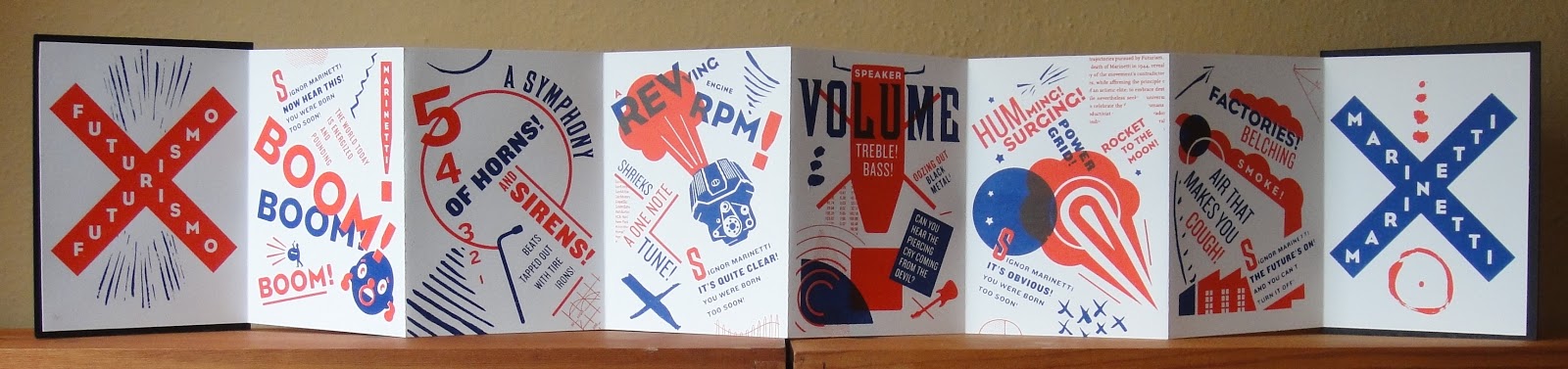
Peter + Maria Hoey, The Loud Atlas, coinop books, 2017, ed. 50


A fun and lively silkscreened book in which the artists have used "...the typographic style of Marinetti and the rhyming cadence of Dr. Seuss, The Loud Atlas takes a surreal and funny look at the noisy world imagined by the Italian Futurists." http://www.coinopbooks.com/product/new-the-loud-atlas/

The Loud Atlas is one in a series of 4 accordion books published by coinop books over years. The others are: "The French Drop," (2015), "Blue Moon Flower Blue," (2016) and "American Noir," (2019). Each book has it's own theme, and all of them illustrate an interesting play with the graphic design and the accordion layout of each issue.

The Loud Atlas pages: height 7.5", and width 5.5", 12 pages, and when opened this accordion is 3ft 8inches long. 


Thursday, November 29, 2018

Hartford: Spring Summer Eighteen, 2018, France


"Hartford was launched in Paris in 1979. Mixing vintage European styles with a more relaxed American aesthetic, the label has gained a cult following for its easy-to-wear pieces, which are perfect for dressing down stylishly. Look out for the linen shirts this season." [source: mrporter.com]

14 pages, each 8" (h) x 5.5" (w), and when extended 3ft 2.5 inches. 


Thursday, November 8, 2018

David Eichenberger, Eric Knisley, Mark McMurray, Adam Meuse, Marx Myth, Busytown: An Exquisite Corpse, 2018 [1st printing, ed. 80]


Another smart exquisite corpse from the crew down in Raleigh, North Carolina. I have reviewed two of their accordions previously (see 'Factory' & 'Tunnel', 2017) with an accompanying statement about the books, and their working methods by Eric Knisley. The present publication sees a larger group of 5 artists collaborating on this work. The final drawing is impressive with subtle and staggered transitions that really help to create the sense that this is one long continuous work. Bravo guys!

30 pages, 9"(h) x 6"(w), when open 15ft long, 1st printing, ed. 80. You can order the book here:


End page and publication details

Tuesday, October 2, 2018

Sara McCall Ephron, Pisschair (2018), Wake Up and Smell the Coffee (2018), Outside (2018), New York City.


A series of 3 really lively accordions by this artist, illustrator and teacher living in New York City. I'll let Sara describe her work and interests and how she came to be using the accordion/concertina format in her recent letter to me:

"My personal interest is metaphor, expressed in words and image, exposing the emotional underbelly-the nebulous caldron of subjective reality. The work I am sending you is part of a series of concertina formatted salty/sweet "Zines" or illustrated rantings I've created under the title PISSCAT, the character thread linking all the stories. Pisscat is representative of the underlying Id-pissed on, pissed off, marking territory, homeless disenfranchised. The stories range from psychedelic rantings to political commentary.

I found an amazing printed, Barefooot Press, that both prints and folds these juicy tidbits into gorgeous, full color, double sided, 4x6 card stock accordion books. So, it is finally possible to begin releasing my little PISSCATS into the wide wide world, to find new homes and new spheres of influence. Thank you for adopting one (or two, or three) I hope you enjoy this spicy, slyly subersive diversion from tapping and scrolling, -and making this pussycat purr."

All 3 publications: 10 pages, double-sided, individual pages 6" (h) x 4" (w), when fully opened 3' 4".


Monday, October 1, 2018

Chinese Pillow Book, China, nd (contemporary)


I purchased this "Chinese Pillow Book" on a whim when I came across it for sale on Etsy for $33. What I received was a contemporary pillow book constructed from sturdy pages that features reproductions of 5 paintings illustrating different sexual positions and scenarios, including one threesome. Historically pillow books appear to have been given to future daughters-in-laws by mother-in-laws on their wedding days. The books served as a kind of sexual manual for the new bride. The tradition is a long one and they can be found in India and Nepal as well other countries. Other types of pillow books move beyond being sexual manuals and are created as places of intimacy in which the writers feel safe to reveal deeply private feelings and experiences. 

8 pages, 7.5" (h) x 4.5" (w), when open 28".


Thursday, July 26, 2018

Monica Ursina Jäger, Topographies, Kodoji Press, Baden, Switzerland, 2014, 1st ed.


This is a remarkable publication, not only for its size but for the breadth of its undertaking. I'm going to let the very able description from Printed Matter, where I purchased it, serve as the explanation for this work.

"For several years Monica Ursina Jäger has been drawing built and natural landscapes inspired by Modernist-style architecture. Her precise works, using media including ink and pigment transfers, combine hope and downfall: on one hand designers’ aspirations, and fantasies, for the future; on the other the dystopia of failure. In creating these works Jäger has assembled a huge stock of images of buildings and environments, both her own photographs and images found in print and online, including rendered as well as completed constructions. Topographies, which is created in collaboration with Winfried Heininger, consists of one, extremely long, accordion-folded image created from hundreds of collaged images from this working archive.
Topographies reproduces the nearly 12 meter long collage one-to-one. The reader can turn the pages to follow the image, as if with a filmic tracking shot, or they can open the publication to its full extent and examine it in a less linear fashion. Whichever way they view it, the route is through man-made, forested and barren landscapes, some sites iconic, some prototypical, with an emphasis on the architectural ambitions of the 1960s. Our viewpoint moves from afar, to close up, the scenes largely in black and white with accents of color that emphasize the chill of the dystopian environments. With few signs of human life, Jäger captures the temporality of the most solid concrete and steel buildings. Like the fictional visions of Cormac McCarthy, this could be a past we have escaped or a future we would like to avoid.
Another landscape running along the back of the image that also frames the collage complements Jäger’s: a dazzle pattern. Dazzle is a form of camouflage used principally in World War I that works on the principle of applying a bold graphic pattern to an object so that discerning its contours becomes difficult, particularly when the object is in motion. The pattern used for Topographies was created by recording forms generated by applying such a pattern to a fictional, rendered landscape. The result is a structure that is impossible to read, which irritates the eye. Bleeding over onto the front of the image, it is one of several factors that destabilize the reading of the landscape. Jäger’s environment is a montage of proximities that become increasingly unlikely the more one observes, while the dazzle pattern echoes this narrative incongruity in visual form.
Monica Ursina Jäger (born 1974) is a Swiss artist, who gained her MA Fine Art at Goldsmiths College and lives and works in London and Zurich. She has participated in important group shows and exhibited widely throughout Europe and beyond. Recent exhibition venues include the Kunsthalle Düsseldorf, Kunstmuseum Thun, Essl Museum - Kunst der Gegenwart, Arroniz Arte Contemporaneo, Mexico and Galeria Pilar, Sao Paulo among others. Her work is part of many private and public collections. This is her first publication with Kodoji Press."
52 pages double-sided, 12" x 8.5", and open at 36' 10".