Thursday, June 2, 2011

Art: From Prehistoric Art to Modernism (Flipguide), 2001, DuMont Buchverlag, Koln

The accordion format is ideally suited to displaying large amounts of information in a sequential and chronological format. This accordion catalogues art works made over the last 35,000 years. 12" (H) 67.50" (W)

Map & Guide to Powell's City of Books, nd, Powell's Books, Portland


A faux old style guide to Powell's bookstore in Portland, Oregon, USA. This accordion catalogue displays the location of different subject areas and where in the store they can be found. Also includes potted history of the bookstore whose first store was opened by Michael Powell in Chicago in 1971.  7.25" (H) 36" (W)

Hamish Fulton, Ajawaan, Art Metropole, Canada, 1987

Brit walk artist Hamish Fulton estimates that since 1969 he has made walks in 26 countries. This publication is the documentation of an 8-day walk in Central Saskatchewan, Canada, by way of Lake Ajawaan in August, 1985. Superimposed on the panoramic image of the lake are columns of four letter words related to the natural environment. 7.5" (H) 52.25" (W) 


Richard Meade (USA) & Jurgen Olbrich (Germany), Los Angeles Photo-Copy-Strip, 1985, photocopy


A cool collaborative photocopy work by these two longtime networkers, publishers and artists. Edition of 17, singed. 8.5" (H) 32.5" (W)

Carlos Pileggi, Pulga: Parque Vitória, 2010, photocopy, Sao Paulo, Brazil


About this 2-sided accordion the artist says, "Pulga Parque Vitória is a compilation of notes and drawings that were made in the past four years at my grandparent’s house. It deals with the passage of time, preservation of memory and the sentimental value that a simple household object can build or gather throughout time.”  6" (H) 59.5" (W) For images of other zines and books by Pileggi see: zines - a set on Flickr

Kurt Ryslavy, Hambourgeois, screen print, Brussels, 1988


Kurt Reslavy was born in Austria in 1961 and now lives in Belgium. This 2-sided accordion mixes text and image in a cool expressionist swirl. For more info about this painter and conceptual artist see: Kurt Ryslavy  10.25" (H) 27.5" (W)

Wednesday, June 1, 2011

Lewis Koch, Double Caution Totem (Book One), Nexus Press, Atlanta, 1993


Presented in a smart slipcase, this contemporary totem is an assemblage of photographs of natural and man-made structures from the urban environment. This is one of a series of three books, all of which comprise smaller versions of the original wall-mounted photographic works. Each original assemblage was made in an edition of 8 and was 108" (H) x 19" (W). This publication is 42" (H) x 8" (W) For further photographs by Koch: https://www.lensculture.com/articles/lewis-koch-touchless-automatic-wonder

Addenda: when Lewis came over a couple of months ago to attend an opening in my home-based gallery, Subspace, it was dark when he tried to enter my back door, he managed to walk into the screen door and wreck it!  No big deal, but he must have been feeling guilty about it, and knowing that I had posted Book One of the trilogy on my blog, he gave me the other two as compensation. I was very happy about that!  The two publications are below titled "Surplus Koan Totem: Book Two," and "Slender Thread Totem: Book Three," 1993.


Saul Steinberg, The Line, The Saul Steinberg Foundation and Nieves, New York City, 1954/2011


In 1954, Saul Steinberg, the celebrated Romanian born cartoonist and artist, was invited by Ernesto Rogers, a partner in the Milan based architectural firm BBPR, to design a series of sgraffito murals for the “Children’s Labyrinth” at the 10th Triennial of Milan.(1) The labyrinth was designed with walls that formed a trefoil ‘clover leaf’ design and Steinberg created four long drawings that were photographically enlarged and then incised into the walls using the sgraffito technique.(2) Each of Steinberg’s drawings drew upon themes close to his heart and were titled: The LineTypes of ArchitectureShores of the Mediterranean, and Cities of Italy.


The Line was first published as an accordion in 2011 by the Swiss publishing house Nieves, and in 2014 they published all four of Steinberg’s drawings as accordions and presented in a slipcase.(3) The central formal feature of this nearly 19 foot accordion is a thin black line that runs just above the midpoint along the whole length of the work. Above and below this line Steinberg has drawn in his inimitable style, scenes of travel, exotic locations, train stations, women’s fashions, palaces, old buildings, grand courtyards and one cat amongst other subjects. There’s a real feeling of improvisation and spontaneity to Steinberg’s ‘laundry line’ of drawings with all of them imbued with an underlying sense of mischievousness that would appeal to the imaginations of young children. 


In some ways this work is a realization of a discussion Steinberg had had with a fellow architectural student, Aldo Buzzi, from 1933 in which “…they found themselves deep into a philosophical discussion of what would happen if an artist drew a single line and allowed it to evolve into a drawing.”(4)


Looking at the larger aspects of this accordion three themes emerge. Firstly, there are its origins as a working prototype for a temporary site-specific work. It would, however, take fifty-seven years before it became available to a much wider audience as an accordion. Alas, Steinberg, never got to see this work as it came out twelve years after his death.(5)


Secondly, this accordion also serves a documentary function in preserving this ephemeral work’s original design and imagery for the future. Thirdly, this accordion is also a children’s book, since its imagery was specifically designed to be installed inside in a child friendly environment. Additionally, the drawings all promise a journey of adventure accompanied by all sorts of twists and turns to keep younger audiences following the line.


Footnotes:


1. The Milan triennial was originally established in 1923 and serves as a showcase for Italian architecture and design, and currently takes place in The Triennale di Milano, a museum of art and design in Milan.


2. Sgraffito is a technique where potters can put a layer of glaze or slip on a piece of pottery, let it dry, then use a pottery carving tool to scratch at if to show the base layer of color.  Sgraffito derives from an Italian word meaning “to scratch.” diamondcoretools.com. Accessed: 4.2.24


3. The original drawings were created on long sheets of paper and then rolled up and mailed from New York to Milan, see: Deirdre Bair, Saul Steinberg: A Biography, Doubleday, New York, 2012, pgs. 325-326.


4. Bair, Deirdre, Saul Steinberg: A Biography, Doubleday, New York, 2012, p. 37.


5. The Line, Nieves, Zurich, 2011, consists of 30 single sided pages, individually

10” x 7.5” and when unfolded 18ft 9”.


front page 


back page


Saturday, May 21, 2011

Jason Middlebrook, A Celebration of Debris, San Francisco Art Institute, 2001


A graduate of the San Francisco Art Institute, this curious and oddly shaped accordion is an offset lithographic print commissioned by the SFAI, December 2001. Signed by artist.  4"-1' (H) 16" (L)

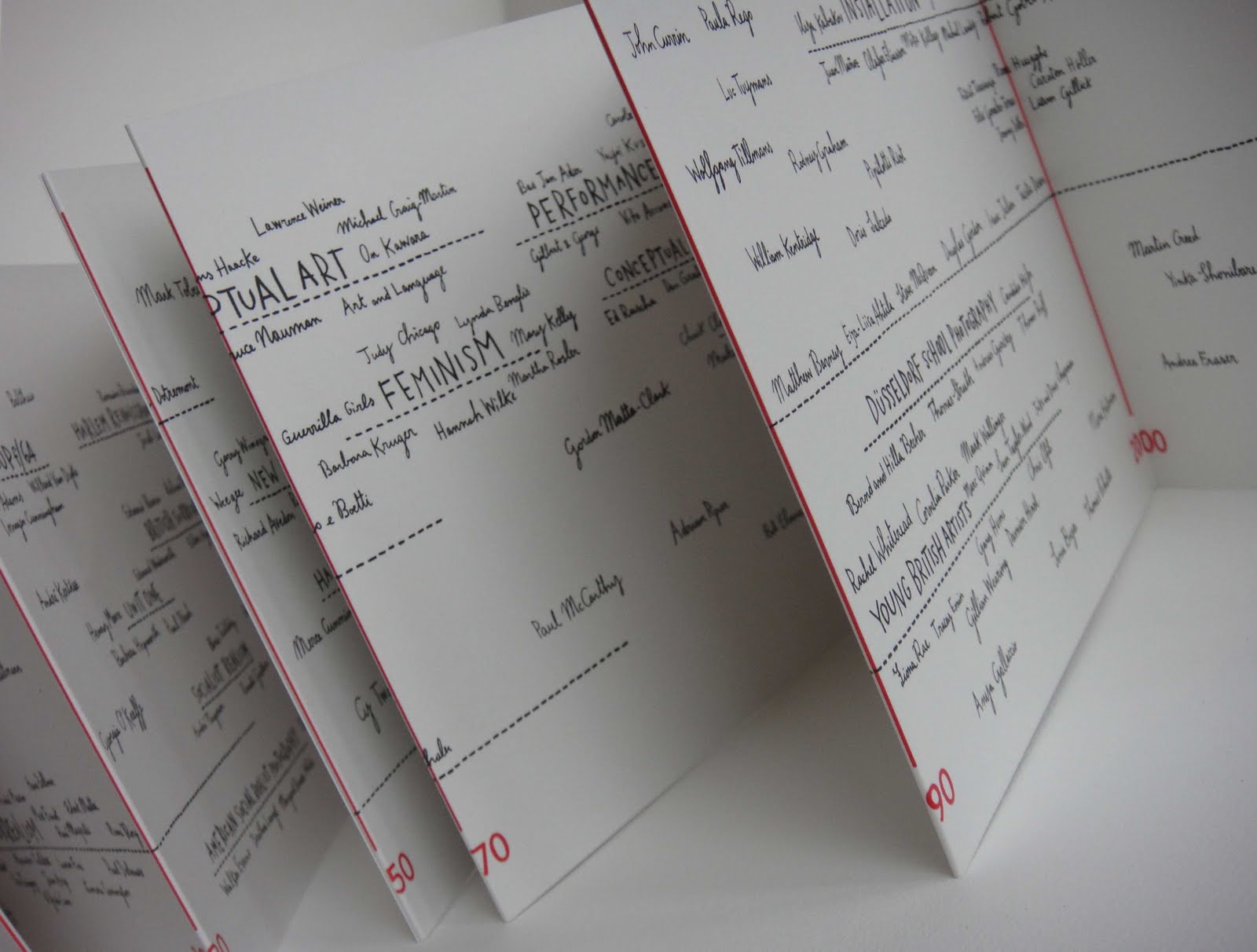
Sara Fanelli, Tate Artist Timeline, Tate Gallery, London, 2006


A handwritten timeline by Sara Fanelli that covers the 20th century and lists all the major artists and movements. This accordion is the published version of the same timeline that's installed on the walls of Levels 3 and 5 at the Tate Modern. The text that accompanies this publication states that Fanelli's handwriting "...is designed to reflect the dynamic nature of twentieth-century art history, rather than something set in stone."  6.25" (H) 75" (L)

The Timechart History of the World, Third Millennium Trust, England, 2004/2008


A 600 year history of the world from Adam and Eve to Barack Obama in 14 feet 9 inches! Originally published as a Victorian wall chart in 1890, this version's timeline has been extended to the year 2008. This is an extraordinarily detailed chart of world events and figures, and the reverse side contains a contemporary timeline of the leaders of China, Russia, Italy, France, Great Britain, Germany and the USA.

The panoramic feature of accordions is obviously well suited to the chronological display and evolution of many different types of subject matter, and these accordions constitute a distinct sub-genre within accordion publications. This type of timeline publication also illustrates the historical linkage with the accordions' predecessor — the scroll.  17.5" (H) 177" (L)