Thursday, November 17, 2022

R. Clarke-Davis, Untitled, Brazil, 2022

front cover

R. Clarke-Davis has been on the road again, this time to Brazil during the run up to the elections there, which thankfully Lula won. More folds than usual in this unexpectedly rich and compact accordion & folded book.

Of varying size, one side 4 pages, each 4" x 5.5", and another side 3 pages of same size. And then unfolding the pages results in sheets of 8, 16 and 12 images respectively. Expect the unexpected with Clarke-Davis' puzzle books.


back of above sheet
 

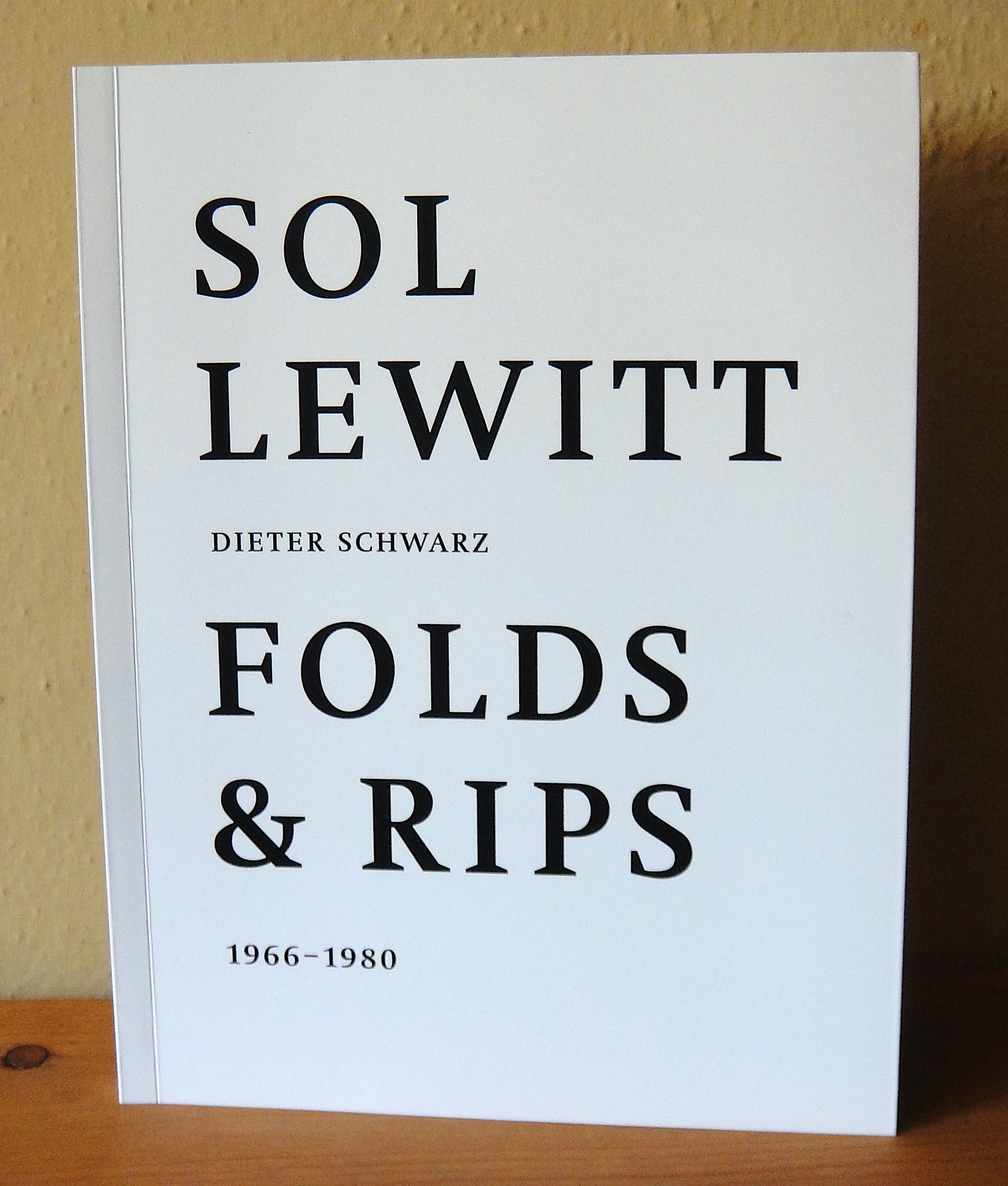
Dieter Schwarz, Sol LeWitt, Folds & Rips: 1966-1980, Walther Konig, Germany, 2020 and Veronica Roberts, Sol LeWitt, Not to be sold for more than $100, Radius Books, Santa Fe, 2020


The deeper I get into the world of accordions the more fascinated I become with the idea and nature of the 'fold', and how it transforms a simple piece of paper into a multi-faceted, and complex object. So, I was excited to discover these two recently published books that explore for the first time an ongoing activity of Sol LeWitt's that consisted of folding, ripping and cutting out sections of printed matter, that he created between the years 1966-1980. There's definitely a continuity between these works and his better known serial works, but these have an intimacy not found in the latter. A lot of the works were circulated within his friendship circles and their apparent simplicity belies the larger issues and themes that they raise.  

LeWitt (1928-2007) described these works as "...drawings without drawing" with lines being replaced by the folds in the paper, and both books explore in different ways the variety of themes and issues that all intersect in this simplest of activities - folding, ripping and cutting of paper.

Here's a link to an excellent article by Megan Liberty from the Brooklyn Rail (Oct. 2020) in which she reviews both books and explores their different coverage of this remarkable and relatively unknown activity of this important conceptual and minimalist artist: Sol LeWitt: Not to Be Sold for More Than $100 and Sol LeWitt: Folds & Rips – The Brooklyn Rail

Tuesday, November 15, 2022

Chuck Close, Scribble Book: Self Portrait, Steidl & Little Steidl, Gottingham, Germany, 2013

Slipcase for the two accordions and pamphlet about the printing process

A really interesting set of three publications from Chuck Close in which he uses the panoramic feature of the accordion to illustrate the process of making a print. Of this work he remarked, "The idea for my scribble self-portrait goes back to an exquisite corpse drawing I made for a show at the Drawing Center in 1993. I wanted to find a way to make a full-color image that was built out of pieces, or in stages, as a print would be made. So I scribbled in colored pencils one color at a time, layering the colors on top of each other, and made a little self-portrait head for the top part of this drawing. I did the process colors first: magenta, then cyan, then yellow and then I would see what else it needed. This is like most of what I do: it's a question of always getting it closer and closer. I sneak up on what I want." [volume 3]

The publishers statement for the trade edition summarizes well the particulars of this publishing project, "Scribble Book is a self-portrait that emerges step-by-step out of the printing process, one plate and one color at a time. The viewer follows a series of nine individual plate proofs (volume 1) along with a corresponding series of nine progressive proofs (volume 2). By comparing the plate proofs against the progressives, the viewer may ascertain not only the effect as one color is added to create the final nine-color-portrait, but also the compositional decisions and careful modifications made by the artist at each stage of the project."

Both accordions: 8 single-sided pages, individually 13.25" x 11", and when extended 7' 4".


the final print is on the right

In volume three Chuck Close describes the printing process


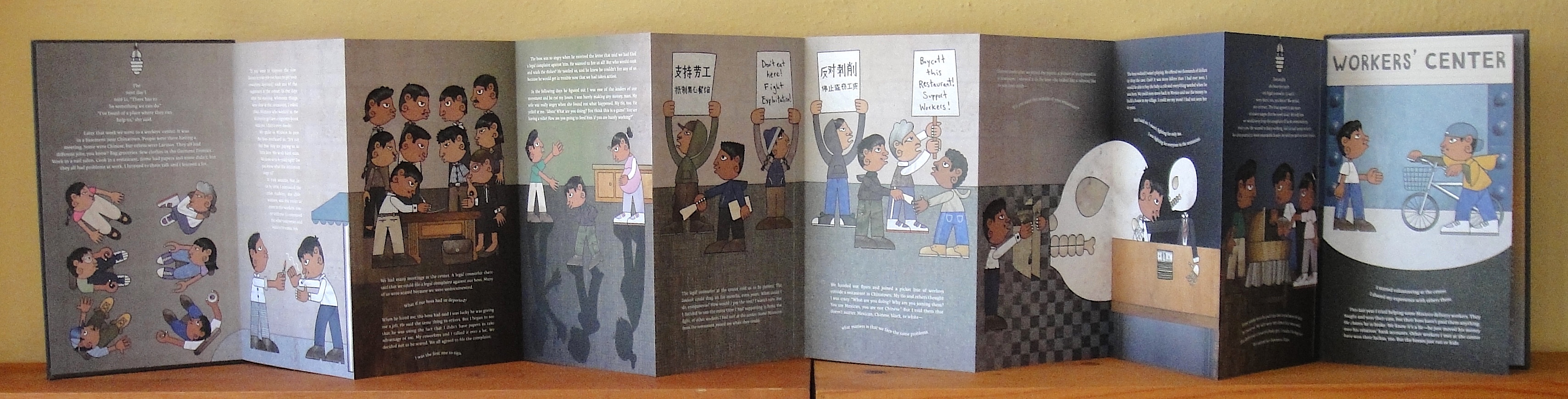
Duncan Tonatiuh, Undocumented: A Worker's Fight, Abrams Books, 2018

front cover and slipcase

A beautifully drawn accordion done in Tonatiuh's unique Neo-Pre-Columbian style, this book tells the story of a group of undocumented workers and their, ultimately successful, organizing efforts at their place of work. This book was inspired by a Mixtec friend that Tonatiuh met at college in New York and it illustrates his journey from a small village in Mexico to his life as a busboy in New York City. This accordion is also a tribute to the long history of pre-Columbian codices that were all but destroyed by the Spanish invaders, and thus this book carries an undercurrent of resistance and, of a contemporary revival. 

Inspired by his research into Mixtec codices and artwork from the 15th century, Tonatiuh recounts that "I decided I was going to make a modern day codex of my friend's story. I've been drawing in a Pre-Columbian like style since."

Born in San Miguel de Allende in Mexico, Tonatiuh has also spent time in the USA having studied at the Parsons School of Design and Eugene Lang College in New York City. He has also established an award winning career and has illustrated numerous books with a particular emphasis on books for children.

11 double-sided pages, individually 10.75" x 6.5" and when fully open 5' 11.5"


reverse side


back cover and slipcase


Karlsson Rixon (photographs) & Mara Lee (text), Nakenakt (Nude), Art and Theory Publishing, Stockholm, Sweden, 2018


One side of this accordion book is a compelling series of photographs that feature the photographer standing nude, with another nude woman draped in various positions around her body. Rixon remains impassive throughout the series, while her partner assumes a variety of uncomfortable looking poses as she clings onto the artists' body. The reverse side of the accordion is taken up with a text by Mara Lee, and since it's all in Swedish, its meaning is unavailable to me.

In a publisher's note about this quietly understated artists' book they write: "The photographs depicts a series of interactions between two bodies. They are portraits of the artist captured in a particular phase in life a phase of intense questioning and reflecting on the body in relation to queerness, trans identity and aging. We are confronted with performative moments of playfulness, intimacy, and deadly seriousness in which one body carries, balances, handles or is invaded by another. Perhaps the two together form a single organism in constant change, a body that doesn't adhere to prevailing notions of what a body should look like and how it should act..."

13 double-sided pages, individually 5.5" x 7.75" and when fully open 8' 4.75".


below is the cover of reverse side of book with Mara Lee's text


Thursday, November 10, 2022

Maguma, Lucky/Happy Hans, Brothers Grimm, text by Gita Wold & Divya Vijayakumar, Tara Books, India, 2021


Based on a German folktale "Hans im Gluck" (Hans in Luck) from the early 19th century, the tale tells the story of Hans who leaves home and works hard for seven years and then returns home to visit his mother. His master, satisfied with his work, gives him a chunk of gold as payment. The story recounts his numerous encounters with people on his way home who eventually relieve him of all his gold, but he's glad to get rid of the gold, and the story suggests that happiness has nothing to do with acquiring or losing material goods. 

The reverse side of this accordion retraces his journey as a computer game in which the gamer is met at each page with the different types of choices Hans had to make, but here it gives the player some agency over Han's choices and the outcome of the game. This is a smart switch from the front side in which everything seemed to be predetermined for poor old Hans!

Maguma's illustrations are certainly up to the task of illustrating this old fashioned morality tale, and he switches nicely to a computer game look on the reverse side.

16 double-sided pages, individually 10" x 6.5", and when fully opened 5' 5".


reverse side


free at last!

four postcards by Maguma are included in the book, with two images from each side

back cover


Maguma, God of Money: Karl Marx, Tara Books, India, 2017


Another cool accordion from the folks at Tara Books. This book is a powerful meditation on the nature of money, illuminated by bringing together extracts from Marx's writings on the same from his 'Economic and Philosophical Manuscripts of 1844.' Maguma's powerful illustrations serve to enhance the slippery nature of money and our own relationship to this powerful economic force in all of our everyday lives.

11 double sided pages, individually 11" x 6", and when fully opened 5' 6". 


reverse side


back cover